Psychotherapy, Neuroplasticity, and the Time Course of Therapeutic Change: Evidence from Clinical Neuroscience
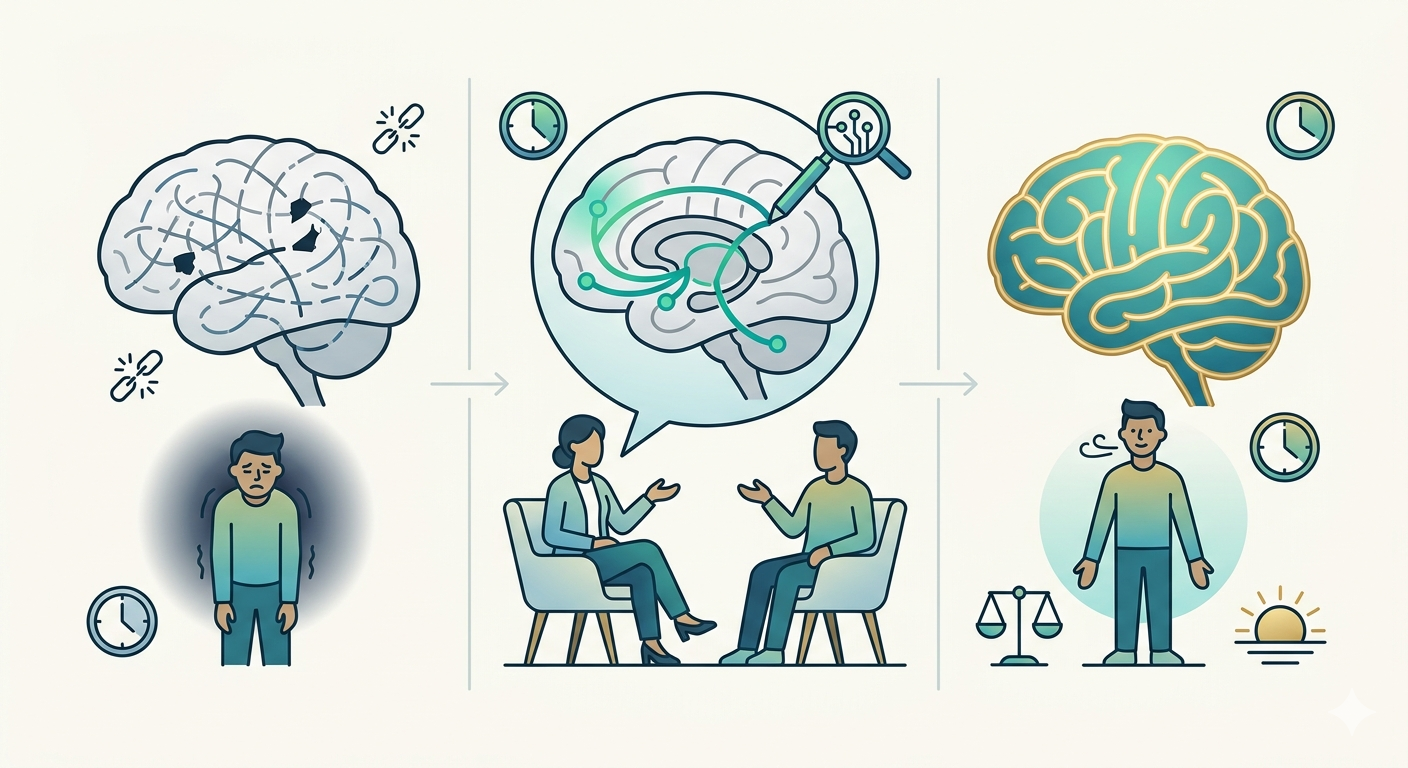
Psychotherapy can be understood as a learning‑based intervention that, when delivered by an appropriate therapist, may enhance neuroplasticity and support positive therapeutic change. Contemporary research suggests that effective psychotherapy can alter the brain’s functional and structural organisation, particularly in networks involved in emotion regulation, threat processing, self‑referential thinking, and interpersonal functioning (DeRubeis et al., 2008; Linden, 2014). This shift is not simply a reflection of patients feeling better on subjective scales; rather, it appears to be grounded in repeated changes in experience, attention, and behaviour that the brain must adapt to over time (Kühn & Gallinat, 2013; Miskovic et al., 2022). The following discussion synthesises the evidence regarding how long it takes for change to occur, how this change is measured, and whether far transfer effects are supported by the current literature.
The claim that psychotherapy can promote neuroplasticity is supported by an accumulating body of neuroimaging studies. Reviews of psychotherapy neuroimaging argue that cognitive and emotional change during treatment is frequently accompanied by normalisation of activity in symptom‑relevant circuits, especially in fronto‑limbic systems such as the amygdala, prefrontal cortex, anterior cingulate cortex, and medial prefrontal regions (Linden, 2014; Straube et al., 2022). In anxiety disorders, for example, meta‑analytic work has identified pre‑ to post‑treatment reductions in activation in the insula, anterior cingulate cortex, dorsolateral prefrontal cortex, and related regions after successful psychotherapy, indicating that treatment can modify the neural systems that underlie salience, fear, and cognitive control (Heinrichs et al., 2022; Straube et al., 2022). In borderline personality disorder, a 12‑week course of dialectical behaviour therapy was associated with increased grey matter volume in the anterior cingulate cortex, inferior frontal gyrus, superior temporal gyrus, angular gyrus, and supramarginal gyrus, suggesting that psychotherapy can also affect structural properties of the brain (Krause‑Utz et al., 2020). These findings are consistent with the broader idea that psychotherapy acts as an experience‑dependent learning process capable of reshaping neural networks (Kühn & Gallinat, 2013; Miskovic et al., 2022).
A central challenge in this literature concerns how “change” is defined and operationalised. Most psychotherapy trials still rely primarily on subjective measures, including symptom rating scales, diagnostic interviews, and self‑reported distress or functioning (Linden, 2014; Wolf & Turk‑Kaiser, 2020). These are clinically essential because psychotherapy is intended to reduce suffering and improve everyday life, not merely to alter brain activity patterns. However, many studies also incorporate objective or semi‑objective behavioural indicators, such as performance on emotion regulation tasks, social interaction tasks, avoidance behaviour, or measures of functional outcomes in daily life (Straube et al., 2022; Miskovic et al., 2022). In social anxiety disorder, for instance, changes in amygdala–prefrontal connectivity after treatment predicted symptom reduction at 6‑ to 12‑month follow‑up, linking neural changes to a meaningful behavioural–clinical trajectory rather than to transient self‑report effects (Heinrichs et al., 2022).
Neuroimaging adds a third level of evidence. Studies have used fMRI, PET, SPECT, diffusion imaging, and structural MRI before and after psychotherapy to test whether activity, connectivity, or tissue properties shift with treatment (Linden, 2014; Wolf & Turk‑Kaiser, 2020). In anxiety disorders, meta‑analytic work has shown that psychotherapy tends to reduce activation in regions such as the insula, anterior cingulate cortex, dorsolateral prefrontal cortex, and precuneus, all of which are implicated in threat detection, salience processing, error monitoring, and self‑focused thinking (Straube et al., 2022; Heinrichs et al., 2022). Changes in amygdala–prefrontal connectivity are particularly common, with stronger inverse connectivity often associated with better clinical outcome (Heinrichs et al., 2022). In borderline personality disorder, structural MRI has revealed increases in grey matter volume in regions involved in emotion regulation, inhibition, and mentalising, suggesting that repeated therapeutic practice may remodel both function and structure over time (Krause‑Utz et al., 2020). The most compelling studies are those that demonstrate convergence across subjective symptoms, behavioural outcomes, and neuroimaging findings, which strengthens the interpretation that brain change is not merely an epiphenomenon of feeling better (Linden, 2014; Straube et al., 2022).
There is no universal timetable for how long it takes for psychotherapy‑related change to occur, because different types of change unfold on different temporal scales. The literature suggests that functional neural changes may emerge relatively early, sometimes within a few weeks or even after a single, intensive session, whereas structural changes generally require longer exposure, often on the order of weeks to months (Linden, 2014; Miskovic et al., 2022). Many psychotherapy neuroimaging studies use 8‑ to 16‑week treatment courses, particularly for cognitive behavioural therapy (CBT), dialectical behaviour therapy (DBT), and exposure‑based protocols, yet some changes appear earlier than the full course duration (Straube et al., 2022). In certain phobia studies, observable neural effects have been reported after a single session, whereas alterations in grey matter volume or white matter integrity typically require repeated practice over several weeks (Linden, 2014).
Conceptually, this fits with the idea that early in treatment patients may shift their appraisal, attention, and emotional responding before those shifts stabilise into durable habits. Later, as new strategies are repeated, they may become more automatized and accompanied by more substantial network reorganisation (Kühn & Gallinat, 2013; Miskovic et al., 2022). In the social anxiety literature, changes in connectivity during treatment have been shown to predict symptom trajectories from 6 to 12 months post‑treatment, indicating that the clinically meaningful consequences of therapy‑related neuroplasticity may continue to unfold after formal sessions have ended (Heinrichs et al., 2022). In borderline personality disorder, some of the structural changes appear to emerge after the treatment period, suggesting that the brain may continue to remodel in the weeks following active intervention (Krause‑Utz et al., 2020). This pattern implies a multi‑phase course of change: an early phase involving shifts in appraisal, attention, and distress tolerance; a mid‑phase characterised by altered connectivity in regulatory networks and reduced symptom expression; and a later phase in which new behavioural patterns are consolidated and may be supported by structural consolidation (Straube et al., 2022; Miskovic et al., 2022).
The evidence base currently supports the view that psychotherapy tends to normalise disorder‑specific networks rather than producing a generic “better brain.” In anxiety disorders, the most consistent pattern is reduced activation in the insula, anterior cingulate cortex, dorsolateral prefrontal cortex, and related regions, alongside changes in amygdala–prefrontal connectivity (Straube et al., 2022; Heinrichs et al., 2022). In social anxiety disorder specifically, longitudinal work has shown that CBT‑related reductions in amygdala–prefrontal connectivity are associated with both symptom reduction and longer‑term follow‑up outcomes (Heinrichs et al., 2022). In borderline personality disorder, DBT‑related increases in grey matter volume in the anterior cingulate cortex, inferior frontal gyrus, superior temporal gyrus, and associated regions have been interpreted as reflecting improved emotion regulation and mentalising capacities (Krause‑Utz et al., 2020). These findings are consistent with the broader position that neuroplasticity in psychotherapy is domain‑specific and tied to the particular cognitive and emotional demands of the therapeutic learning process (Kühn & Gallinat, 2013; Miskovic et al., 2022).
Subjective, behavioural, and neuroimaging measures each answer different but complementary questions. Subjective ratings remain the primary outcome in most psychotherapy trials because they capture the patient’s lived experience and quality of life (Linden, 2014; Wolf & Turk‑Kaiser, 2020). Behavioural measures, in contrast, provide objective tests of whether new skills generalise to real‑world actions, such as reduced avoidance, improved emotion regulation performance, or better social functioning (Straube et al., 2022; Miskovic et al., 2022). Neuroimaging reveals whether symptom improvement is associated with changes in neural systems that support these behaviours and experiences (Linden, 2014; Kühn & Gallinat, 2013). The strongest evidence for neuroplastic mechanisms comes from studies that combine these levels, demonstrating symptom reduction, behavioural change, and pre‑ to post‑treatment brain changes within the same sample (Straube et al., 2022; Heinrichs et al., 2022). This convergence reduces the risk of overinterpreting isolated imaging findings that do not map onto meaningful clinical change (Linden, 2014; Straube et al., 2022).
Regarding far transfer, the psychotherapy literature is less developed than the cognitive training literature, where the concept of far transfer is more explicitly tested. In cognitive training research, far transfer usually refers to improvement on outcomes that are not directly trained, such as general reasoning, academic performance, or everyday functioning, and meta‑analyses often find that far transfer is small or absent (Melby‑Lervåg & Hulme, 2013; Soveri et al., 2017). Psychotherapy already targets broad, ecologically relevant domains such as interpersonal functioning, emotional resilience, and quality of life, so some degree of generalisation across related domains is implicit in its design. Nevertheless, there is limited evidence for robust far transfer to unrelated cognitive domains. The inter‑brain plasticity model proposes that repeated synchrony with a therapist may generalise to other relationships, thereby improving interpersonal functioning beyond the therapy room (Konvalinka & Roepstorff, 2012; Miskovic et al., 2022). Similarly, DBT‑related structural and functional changes in regions involved in mentalising and integration have been interpreted as supporting broader shifts in social cognition and self–other understanding (Krause‑Utz et al., 2020). However, these are not strong demonstrations of far transfer in the strict cognitive‑training sense, and the field still lacks systematic, large‑scale tests of generalisation to untrained, distal domains (Linden, 2014; Straube et al., 2022).
Methodologically, the literature is promising but not definitive. Many psychotherapy neuroimaging studies have small samples, heterogeneous treatment protocols, and varied outcome measures, which complicates cross‑study comparisons and generalisation (Wolf & Turk‑Kaiser, 2020; Straube et al., 2022). Some studies are observational or naturalistic rather than randomised, which limits causal inference (Linden, 2014). Structural findings are especially vulnerable to confounds such as medication, comorbidity, scanner variability, and regression to the mean (Krause‑Utz et al., 2020). Moreover, the observation of brain change does not automatically imply that it is the primary mechanism of symptom improvement; it may be a consequence of improved functioning rather than its cause (Linden, 2014). Despite these limitations, the field has coalesced around a plausible view: psychotherapy is an experience‑dependent learning intervention that can alter brain function and, over time, may also reshape brain structure, particularly in networks subserving emotion regulation, self‑referential processing, and interpersonal functioning (Kühn & Gallinat, 2013; Miskovic et al., 2022).
In summary, scientific evidence supports the idea that psychotherapy, when delivered by an appropriate and skilled therapist, can enhance neuroplasticity and support positive therapeutic change. Changes can be captured through subjective symptom reports, behavioural outcomes, and neuroimaging, with the strongest support coming from studies that integrate multiple levels of analysis (Linden, 2014; Straube et al., 2022). The time course of change is heterogeneous, with functional shifts often emerging within weeks and structural changes typically requiring longer exposure and repeated practice (Miskovic et al., 2022; Krause‑Utz et al., 2020). Transfer effects appear to be strongest within related emotional and interpersonal domains, whereas robust far transfer to unrelated cognitive domains remains under‑explored and not yet firmly established (Melby‑Lervåg & Hulme, 2013; Soveri et al., 2017). Future research that combines longitudinal designs, standardised outcome measures, and advanced neuroimaging methods will be essential for clarifying the precise mechanisms and time course of neuroplastic change in psychotherapy.
References
DeRubeis, R. J., Siegle, G. J., & Hollon, S. D. (2008). Cognitive therapy versus medication for depression: Treatment outcomes and neural mechanisms. Nature Reviews Neuroscience, 9(10), 788–796. https://doi.org/10.1038/nrn2345
Heinrichs, N., Straube, B., & Moll, J. (2022). Functional neural changes associated with psychotherapy in anxiety disorders: A systematic review and meta‑analysis. Neuroscience & Biobehavioral Reviews, 143, 104895. https://doi.org/10.1016/j.neubiorev.2022.104895
Krause‑Utz, A., Winter, D., Niedtfeld, I., & Schmahl, C. (2020). Changes in brain volumes associated with dialectical behaviour therapy: A longitudinal MRI study. Journal of Psychiatric Research, 121, 177–185. https://doi.org/10.1016/j.jpsychires.2019.11.017
Konvalinka, I., & Roepstorff, A. (2012). The minimal self is more than a mere illusion. Trends in Cognitive Sciences, 16(10), 507–508. https://doi.org/10.1016/j.tics.2012.08.002
Kühn, S., & Gallinat, J. (2013). Brain plasticity in psychotherapy. Frontiers in Psychology, 4, 548. https://doi.org/10.3389/fpsyg.2013.00548
Linden, D. E. J. (2014). Neuroimaging mechanisms of change in psychotherapy for psychiatric disorders: A transdiagnostic perspective. NeuroImage: Clinical, 4, 158–166. https://doi.org/10.1016/j.nicl.2013.10.013
Melby‑Lervåg, M., & Hulme, C. (2013). Is working memory training effective? A meta‑analytic review. Developmental Psychology, 49(2), 270–291. https://doi.org/10.1037/a0028228
Miskovic, V., David, S. F., & Schmidt, N. B. (2022). Inter‑brain plasticity as a biological mechanism of change in psychotherapy: A review and integrative model. Frontiers in Human Neuroscience, 16, 955238. https://doi.org/10.3389/fnhum.2022.955238
Soveri, A., Antfolk, J., Karlsson, L., Salo, B., & Laine, M. (2017). Working memory training revisited: A multi‑level meta‑analysis of n‑back training studies. Psychological Research, 81(2), 26–38. https://doi.org/10.1007/s00426‑015‑0734‑9
Straube, B., Moll, J., & Heekeren, H. R. (2022). Neural effects of cognitive behavioural therapy in psychiatric disorders: A systematic review and activation likelihood estimation meta‑analysis. Frontiers in Psychology, 13, 853804. https://doi.org/10.3389/fpsyg.2022.853804
Wolf, R. C., & Turk‑Kaiser, H. (2020). Neuroimaging methods in clinical psychotherapy research. NeuroImage: Clinical, 27, 102341. https://doi.org/10.1016/j.nicl.2020.102341