Polyvagal Theory: Neurophysiological Mechanisms of Safety and Social Behavior
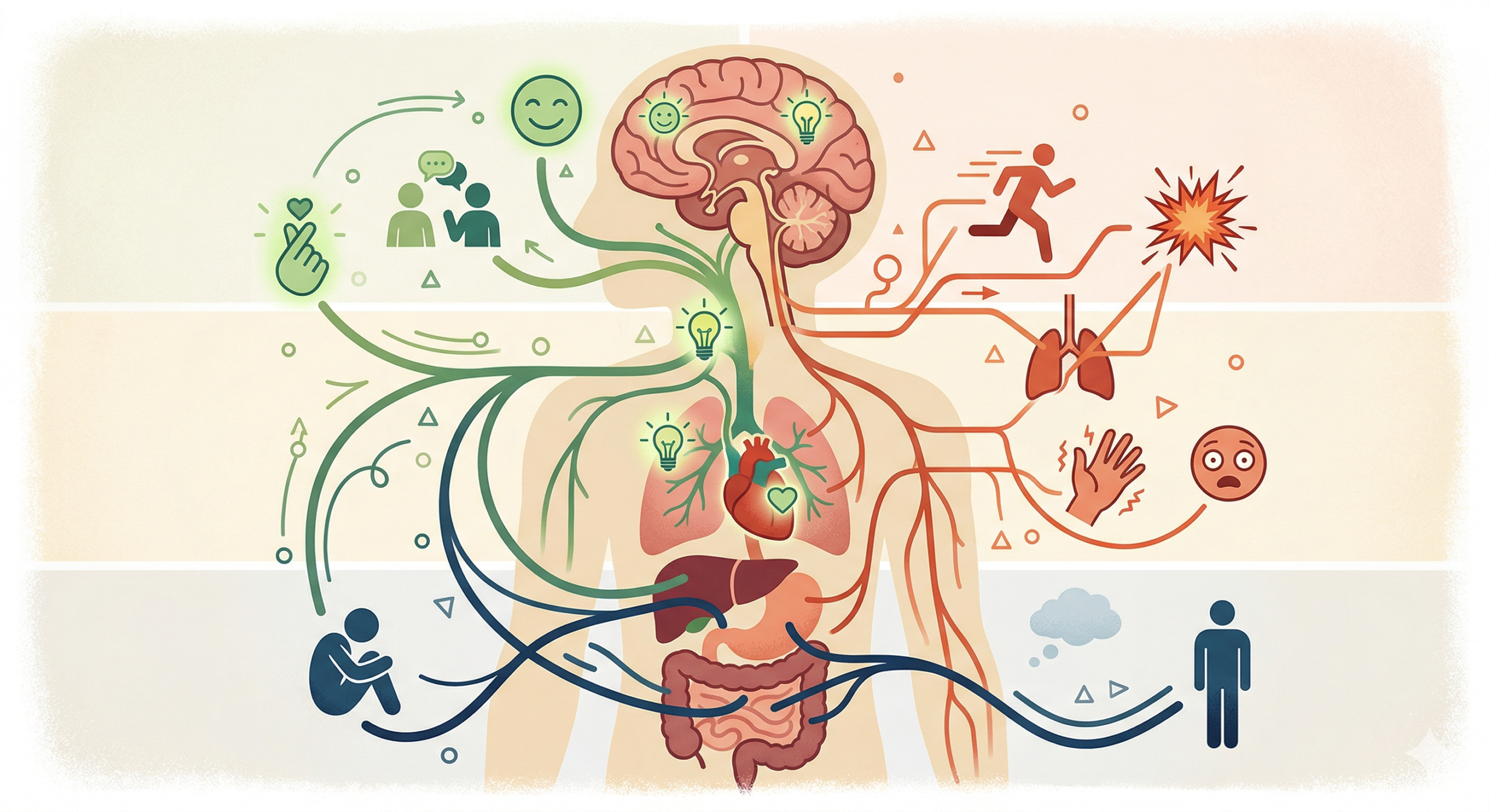
Polyvagal theory is a neurophysiological framework developed by Stephen Porges to explain how the autonomic nervous system supports adaptation in relation to safety, threat, and social behavior (Porges, 2007, 2011). The theory argues that autonomic state is not simply a matter of overall arousal, but reflects organized response patterns that shape emotion regulation, behavior, and social engagement (Porges, 2007, 2011). In this account, the nervous system continuously monitors environmental cues and shifts between states that support social interaction, defensive mobilization, or immobilization depending on the level of perceived safety or danger (Porges, 2007, 2011).
The central idea is that the autonomic nervous system contains functionally distinct response patterns that support different types of survival behavior (Porges, 2007, 2011). When a person perceives safety, the ventral vagal system is thought to support calm physiological regulation and social engagement, which facilitates speaking, listening, maintaining eye contact, and coordinating with others (Porges, 2011). When danger is detected, the organism may shift toward sympathetic activation, which prepares the body for fight-or-flight responses; in more extreme situations, dorsal vagal processes may contribute to shutdown or immobilization-like states (Porges, 2007, 2011).
A key concept in polyvagal theory is neuroception, which refers to the automatic, nonconscious detection of cues that signal safety, danger, or life threat (Porges, 2007, 2011). Unlike conscious appraisal, neuroception operates outside awareness and can influence autonomic state before a person has time to interpret the situation intellectually (Porges, 2007). In practice, this means that features such as facial expression, vocal prosody, body posture, predictability, and interpersonal distance can all affect whether the nervous system organizes around social engagement or defensive responses (Porges, 2011; Dana, 2018).
Polyvagal theory also emphasizes a social engagement system, which links autonomic regulation with facial muscles, vocal prosody, gaze, and listening behavior (Porges, 2011). The theory proposes that neural circuits involved in regulating the heart are coordinated with systems involved in communication, so social behavior is an integral part of physiological regulation rather than a separate process (Porges, 2011). When the organism is in a relatively safe state, these systems support affiliation and flexible interaction; when threat dominates, those capacities become less available because the system prioritizes defense (Porges, 2007, 2011).
Polyvagal theory is widely used in fields that study safety, social behavior, and psychopathology because it provides a neurophysiological account of how internal states shape interpersonal functioning (Porges, 2011; Dana, 2018). In conditions associated with trauma or chronic stress, people may spend more time in defensive autonomic states, which can interfere with social engagement, emotional processing, and trust (van der Kolk, 2014). From this perspective, interventions that repeatedly present cues of safety and regulated social interaction may help shift autonomic state in directions that support more adaptive social behavior (Porges, 2011; van der Kolk, 2014).
Although polyvagal theory is influential, some of its claims remain under discussion in neuroscience and physiology, especially the interpretation of respiratory sinus arrhythmia and its relation to vagal tone (Grossman & Taylor, 2007). Respiratory sinus arrhythmia is often used as an index of parasympathetic activity, but its relationship to vagal tone is not simple and can be affected by breathing patterns and other physiological variables (Grossman & Taylor, 2007; Grossman et al., 1991). For that reason, the theory is best treated as a useful explanatory framework for understanding the neurophysiological mechanisms linking safety and social behavior, while recognizing that the empirical foundations of some details are still being refined (Porges, 2007, 2011).
References
Dana, D. (2018). The polyvagal theory in therapy: Engaging the rhythm of regulation. W. W. Norton & Company.
Grossman, P., & Taylor, E. W. (2007). Toward understanding respiratory sinus arrhythmia: Relations to cardiac vagal tone, evolution and biobehavioral functions. Biological Psychology, 74(2), 263–285. https://doi.org/10.1016/j.biopsycho.2005.11.014
Grossman, P., van Beek, J., & Wientjes, C. (1991). Respiratory sinus arrhythmia, cardiac vagal tone, and respiration. Biological Psychology, 41(1–2), 65–77. https://doi.org/10.1016/0301-0511(91)90018-5
Porges, S. W. (2007). The polyvagal perspective. Biological Psychology, 74(2), 116–143. https://doi.org/10.1016/j.biopsycho.2006.06.009
Porges, S. W. (2011). The polyvagal theory: Neurophysiological foundations of emotions, attachment, communication, and self-regulation. W. W. Norton & Company.
Porges, S. W., & Furman, S. A. (2011). The early development of the autonomic nervous system provides a neural platform for social behavior: A polyvagal perspective. Infant and Child Development, 20(1), 106–118. https://doi.org/10.1002/icd.688
van der Kolk, B. A. (2014). The body keeps the score: Brain, mind, and body in the healing of trauma. Viking.