Psychotherapy as a Socially Safe Environment: Neuroplasticity, Trauma Reduction, and Therapeutic Change
Introduction
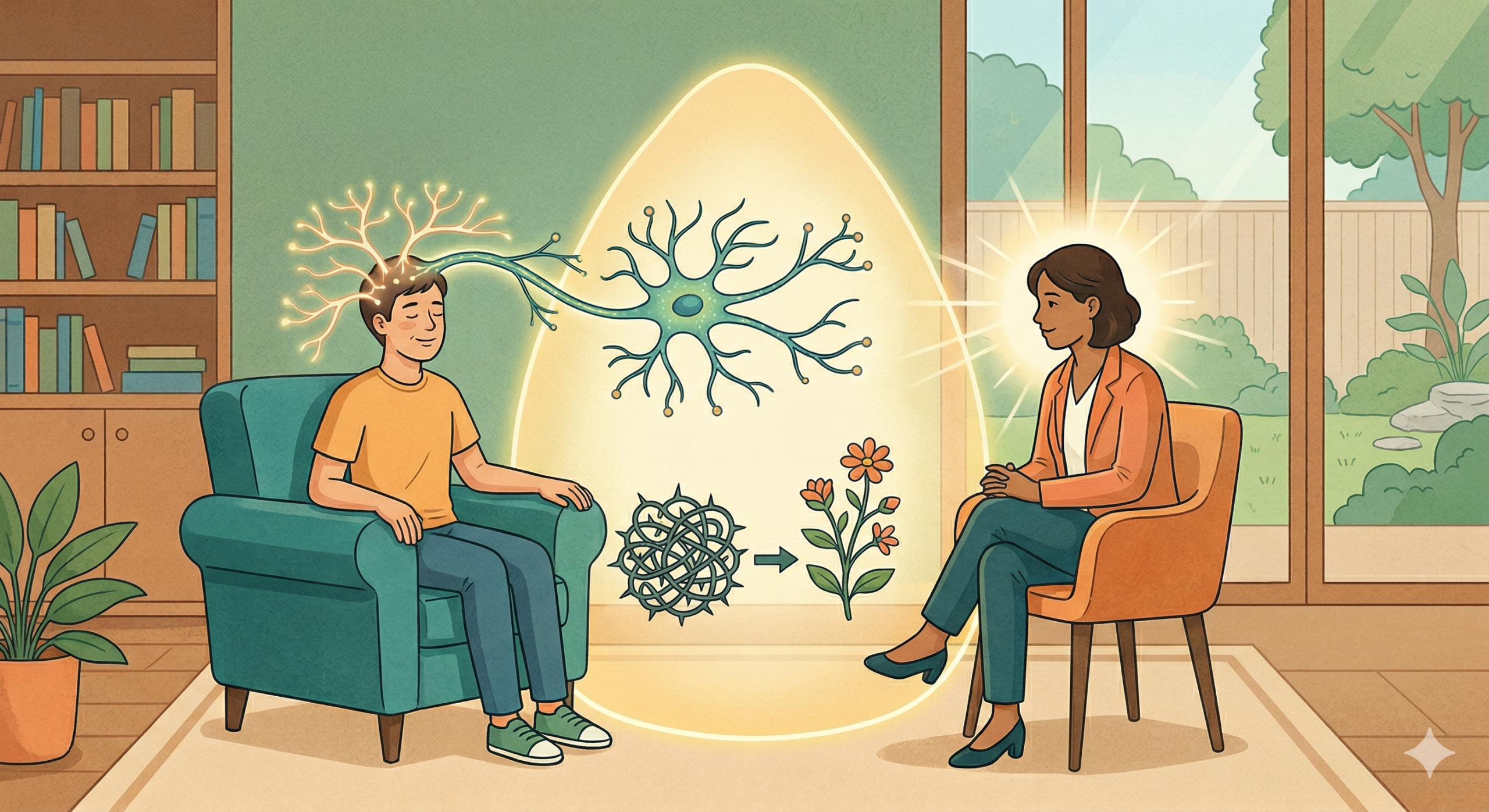
Psychotherapy is a structured interpersonal intervention that may influence emotion regulation, cognition, and behavior through both psychological and neurobiological mechanisms. One relevant feature is that therapy provides a socially safe context in which distressing material can be examined with reduced threat and increased interpersonal support (Porges, 2011; Schore, 2012). This article reviews evidence that the therapeutic relationship may support regulation and learning, that socially structured mental training can induce neuroplastic change, and that these processes are relevant to trauma treatment (Davidson & McEwen, 2012; Koole & Tschacher, 2016; Valk et al., 2017).
Therapeutic relationship and safety
Perceived safety is central to effective psychotherapy. In polyvagal theory, cues of safety support autonomic regulation and social engagement, whereas cues of threat promote defensive responses (Porges, 2011). In clinical terms, an empathic and consistent therapist may help patients remain within a range of arousal that supports reflection rather than avoidance or dissociation (Schore, 2012).
Evidence from interpersonal synchrony research supports this view. Koole and Tschacher (2016) reviewed findings showing that therapist and patient can spontaneously synchronize in movement, speech, and physiological activity, and argued that these processes are associated with the therapeutic alliance. Their model does not prove that synchrony causes change, but it offers a plausible mechanism by which the interaction itself may support treatment progress (Koole & Tschacher, 2016).
Social experience and neuroplasticity
Neuroplasticity refers to experience-dependent changes in brain structure and function. Social experience is one of the factors that can shape these changes across development and adulthood (Davidson & McEwen, 2012). In this context, psychotherapy may be viewed as a repeated social learning environment that combines emotional engagement, feedback, and regulation.
A useful supporting study is Valk et al. (2017), who found that nine months of mental training in healthy adults was associated with structural and functional changes in the social brain. Although this study was not psychotherapy, it shows that sustained training in attention, perspective taking, and compassion can alter neural systems relevant to social cognition and self-regulation (Valk et al., 2017). More recent work has extended this logic to psychotherapy by proposing an inter-brain plasticity model, according to which repeated synchrony in therapy may gradually improve a person’s capacity for interpersonal coordination (Shamay-Tsoory et al., 2022).
Trauma treatment
The relevance of these mechanisms is especially clear in trauma treatment. Trauma is often associated with dysregulated arousal, avoidance, and difficulties integrating autobiographical memory and bodily states (van der Kolk, 2014). A therapeutic setting that is stable, predictable, and relationally safe may therefore be necessary for trauma-focused work to proceed effectively.
It is better to state cautiously that trauma-focused therapies can reduce symptoms and alter emotion processing, rather than to claim specific neuroimaging effects unless those are directly shown in a given study. The broader point is that successful treatment likely depends on both technique and relationship, with safety and regulation serving as prerequisites for deeper processing (van der Kolk, 2014; Shamay-Tsoory et al., 2022).
Discussion
Taken together, the literature supports a modest but coherent account of psychotherapy. The therapy relationship can provide safety and co-regulation, synchrony may be one measurable feature of that relationship, and repeated social interaction may contribute to plastic changes in networks involved in emotion regulation and social cognition (Koole & Tschacher, 2016; Davidson & McEwen, 2012; Valk et al., 2017). In trauma treatment, these properties may help patients tolerate distress, reduce avoidance, and consolidate new patterns of responding (Porges, 2011; van der Kolk, 2014).
The strongest direct evidence for neuroplasticity comes from mental training studies rather than psychotherapy trials, so the field should avoid overstating the data. The inter-brain plasticity account is best treated as a promising model rather than an established mechanism (Shamay-Tsoory et al., 2022). Even so, the available evidence supports the view that psychotherapy is more than conversation: it is a structured social context that can facilitate change.
References
Davidson, R. J., & McEwen, B. S. (2012). Social influences on neuroplasticity: Stress and interventions to promote well-being. Nature Neuroscience, 15(5), 689–695. https://doi.org/10.1038/nn.3093
Koole, S. L., & Tschacher, W. (2016). Synchrony in psychotherapy: A review and an integrative framework for the therapeutic alliance. Frontiers in Psychology, 7, 862. https://doi.org/10.3389/fpsyg.2016.00862
Porges, S. W. (2011). The polyvagal theory: Neurophysiological foundations of emotions, attachment, communication, and self-regulation. W. W. Norton & Company.
Schore, A. N. (2012). The science of the art of psychotherapy. W. W. Norton & Company.
Shamay-Tsoory, S. G., Zilcha-Mano, S., & colleagues. (2022). Inter-brain plasticity as a biological mechanism of change in psychotherapy: A review and integrative model. Frontiers in Human Neuroscience, 16, 955238. https://doi.org/10.3389/fnhum.2022.955238
Valk, S. L., Bernhardt, B. C., Trautwein, F.-M., Böckler, A., Kanske, P., Guizard, N., Collins, D. L., & Singer, T. (2017). Structural plasticity of the social brain: Differential change after socio-affective and cognitive mental training. Science Advances, 3(10), e1700489. https://doi.org/10.1126/sciadv.1700489
van der Kolk, B. A. (2014). The body keeps the score: Brain, mind, and body in the healing of trauma. Viking.