Is Your Therapist a Good Fit? A Guide Based on Professional Standards
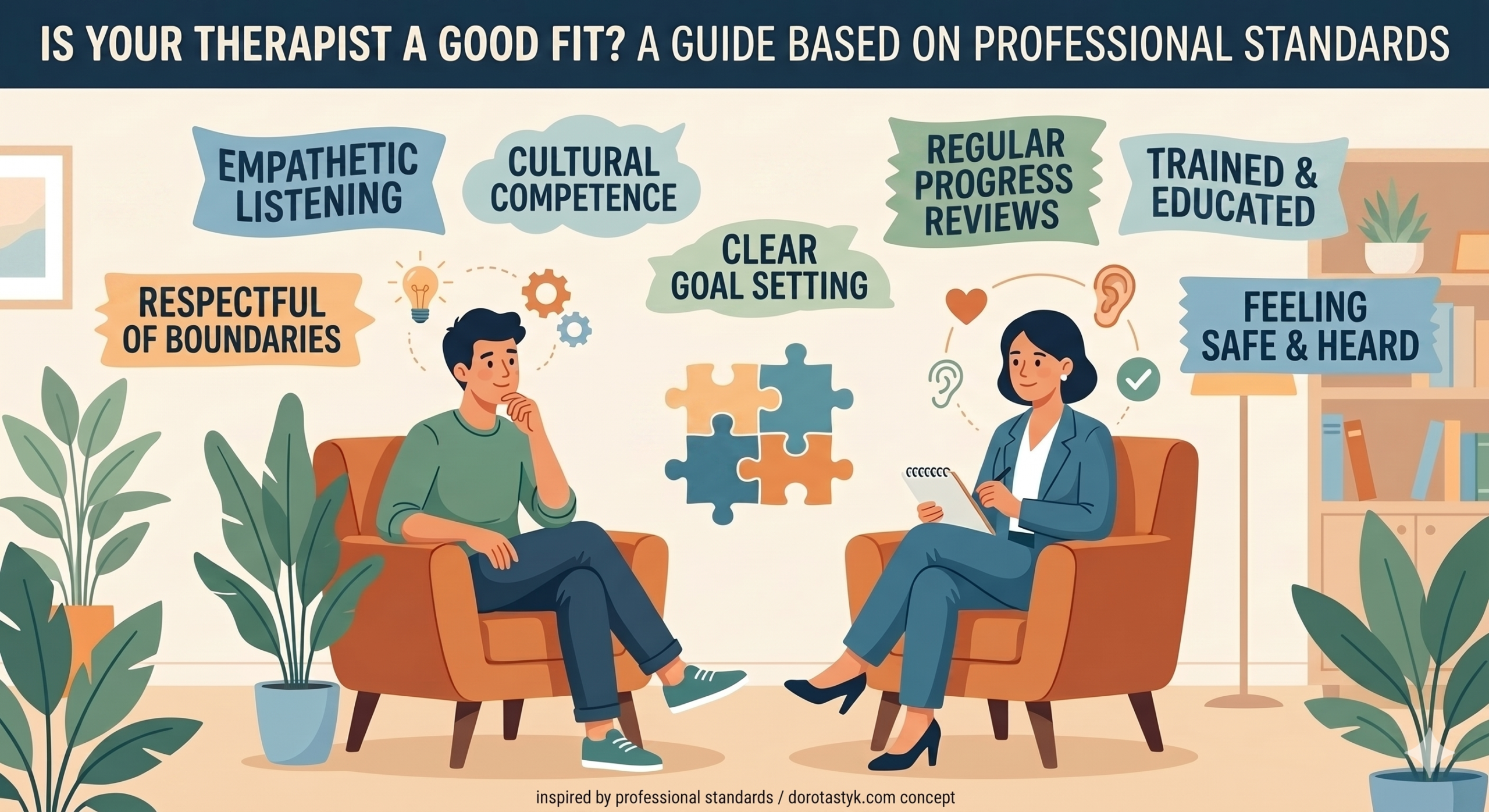
Finding a therapist who is the right fit for you is one of the most important steps in your mental health journey. Research consistently shows that the quality of the relationship between you and your therapist, often called the “therapeutic alliance,” is a stronger predictor of positive outcomes than the specific therapy technique used (British Association for Counselling and Psychotherapy [BACP], 2018).
In the UK, while there is no legal requirement for a therapist to be registered with a professional body, the standards set by organisations such as the British Association for Counselling and Psychotherapy (BACP) , the British Psychological Society (BPS) , and the training outcomes of the Counselling & Psychotherapy Central Awarding Body (CPCAB) represent the gold standard for safe, ethical, and effective practice. Whether or not a therapist holds a specific registration, following these ethical frameworks is of utmost importance for your safety and wellbeing.
The Foundation: BACP, BPS, and CPCAB Standards
The BACP Ethical Framework (BACP, 2018) states that being trustworthy is fundamental to resolving ethical issues, with confidentiality arising from the client’s trust. The framework also lists essential personal qualities for practitioners, including empathy, sincerity, integrity, resilience, respect, and courage (BACP, 2018). Any ethical therapist, regardless of registration status, should demonstrate these qualities.
The British Psychological Society (BPS) similarly maintains a Code of Ethics and Conduct that sets high standards of professionalism and promotes ethical behaviour, attitudes, and judgements on the part of its members (BPS, 2021). The BPS Code acknowledges that ethical reasoning is often subject to biases and emphasises that members should use their own professional and ethical judgement alongside the Code’s principles (BPS, 2021).
Therapists trained through CPCAB (2020) have demonstrated proficiency in key areas, including working ethically and safely, working within a counselling relationship, and working with a user-centred approach. This means that your goals and values should guide the therapy, not the therapist’s personal opinions.
Why the Therapeutic Relationship Matters Most
BACP, BPS, and CPCAB all place the therapeutic relationship at the centre of effective practice. Research recognised by the BACP shows that isolating therapeutic methods from the counselling relationship is ineffective (BACP, 2018). The human connection between you and your therapist is often what heals old wounds and promotes growth.
The BPS has also highlighted the importance of the therapeutic alliance. According to BPS guidance, the therapeutic alliance is “vital as both the medium through which therapeutic change is effected and also as a means of providing a degree of change in and of itself” (British Psychological Society, n.d.). The resolution of difficulties within the therapeutic alliance can be of therapeutic benefit and is necessary for therapy to be effective (British Psychological Society, n.d.).
A user-centred approach means you should feel like an active collaborator. As CPCAB (2020) highlights, working within a user-centred framework requires the therapist to prioritise your needs, identity, and goals throughout the process.
Signs of a Good Fit
Based on professional standards, here are clear signs that a therapist is a good fit for you.
| Professional Standard | What This Looks Like in Practice |
|---|---|
| Trustworthiness and confidentiality (BACP, 2018; BPS, 2021) | You feel safe enough to be honest. The therapist explains the boundaries of confidentiality clearly from the start. |
| Empathy and respect (BACP, 2018) | You feel genuinely heard and understood, without being judged or shamed. |
| Integrity and sincerity (BACP, 2018; BPS, 2021) | The therapist is clear about their qualifications, experience, and what you can expect from therapy. |
| Self-awareness and resilience (BACP, 2018; CPCAB, 2020; BPS, 2021) | The therapist has completed their own personal therapy, a requirement of CPCAB training, and can handle strong emotions without becoming defensive. The BPS Code also encourages members to be mindful of their strengths and weaknesses to behave in the most ethical way possible (BPS, 2021). |
| Working relationally | The therapist is interested not only in the content of what you say, but also in the relationship forming between you. The BPS recognises that the therapeutic alliance is central to achieving therapeutic change (British Psychological Society, n.d.). |
Red Flags: When a Therapist Is Not a Good Fit
There are also clear warning signs that indicate a therapist is not practising safely or ethically, regardless of whether they hold a particular registration.
-
Boundary violations: The BACP (2018) and the United Kingdom Council for Psychotherapy (UKCP, 2019) explicitly state that romantic or personal relationships with current clients are strictly prohibited. A therapist who tries to be your friend, asks for favours, or initiates romantic contact is violating fundamental ethics.
-
Lack of supervision: Ethical frameworks require therapists to have regular clinical supervision to ensure safe practice (BACP, 2018). A therapist who dismisses the value of supervision is not practising professionally.
-
Inadequate personal therapy: CPCAB (2020) requires trainees to complete their own personal therapy to ensure they are fit to practise. A therapist who has not done this work may lack essential self-awareness.
-
Breaching confidentiality: Sharing details of your case without a lawful and ethical reason is a serious breach of trust (BACP, 2018; BPS, 2021).
-
Dominating or lecturing: Instead of collaborating, a poor-fit therapist may interrupt, tell you what to do, or make you feel ashamed. This contradicts the user-centred approach required by CPCAB (2020).
Questions to Ask a Potential Therapist
To assess whether a therapist follows professional standards, consider asking the following questions.
-
“How do you approach clinical supervision to ensure your work remains ethical and effective?”
-
“How do you handle it if I disagree with you or feel hurt by something you say?” This tests their ability to repair relationship ruptures, which the BPS identifies as necessary for therapy to be effective (British Psychological Society, n.d.).
-
“How do you ensure our work stays focused on my goals, rather than just what you think is important?”
-
“What training or qualifications do you have, and how do you keep your knowledge up to date?”
Final Thoughts
There is no legal requirement for a therapist to be registered with a specific body in the UK. However, following established ethical frameworks from organisations such as the BACP and BPS is of utmost importance for your safety and for the effectiveness of therapy (BACP, 2018; BPS, 2021). A good therapeutic fit is not a luxury; it is a clinical necessity. A professional, ethical therapist will actively work to create a relationship that is trustworthy, respectful, and focused entirely on your wellbeing. If something feels wrong, trust your instincts. You have the right to ask questions, seek a second opinion, or find another therapist.
References
References
British Association for Counselling and Psychotherapy. (2018). Ethical framework for the counselling professions. BACP. https://www.bacp.co.uk/events-and-resources/ethics-and-standards/ethical-framework-for-the-counselling-professions/
British Psychological Society. (2021). Code of ethics and conduct. BPS. https://www.bps.org.uk/guideline/code-ethics-and-conduct
British Psychological Society. (n.d.). Alliance ruptures: Etiology and resolution. BPS Explore. https://explore.bps.org.uk/
Counselling & Psychotherapy Central Awarding Body. (2020). Level 4 diploma in therapeutic counselling: Qualification specification. CPCAB.
United Kingdom Council for Psychotherapy. (2019). UKCP code of ethics and professional practice. UKCP.